
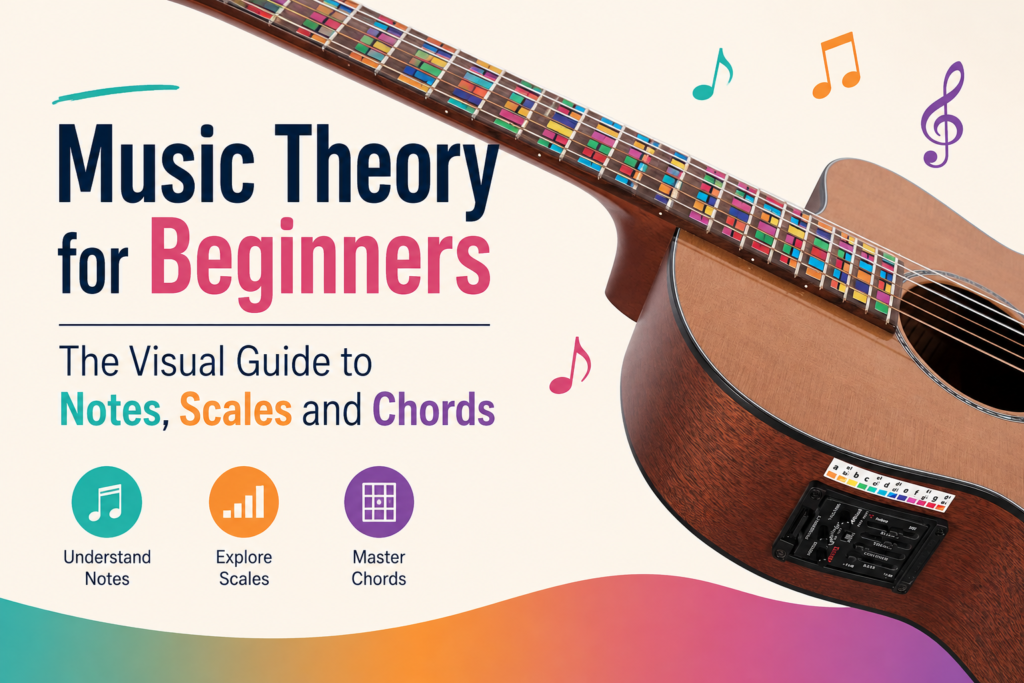
Music theory has a reputation that it does not entirely deserve. Most people hear the phrase and immediately imagine a conservatory classroom full of notation, Roman numerals, and rules that seem designed to drain the joy out of playing. The reality is that music theory is simply the study of how music works — and when you approach it visually rather than academically, it becomes one of the most useful things you can learn as a musician.
This guide covers everything a beginner needs to understand: what notes are, how scales work, what chords are built from, and how all three relate to each other. It is written for people who play an instrument or want to, not for people who want to pass a music exam.
What Is Music Theory and Why Does It Matter
At its most basic, music theory is a set of patterns. Notes are sounds with specific pitches. Scales are ordered sequences of notes that give a piece of music its mood and key. Chords are groups of notes played simultaneously that create harmony. Understanding how these three elements relate to each other is what separates a musician who can follow instructions from one who can create, improvise, and express something original.
The difficulty most beginners have is not with the concepts themselves. It is with the gap between understanding something on paper and being able to apply it on an actual instrument. A beginner can read that C major contains the notes C, D, E, F, G, A, and B — but if they cannot immediately identify where those notes sit on their guitar or other fretboard instrument, the knowledge stays theoretical and never becomes musical.
This is the problem the Musical Colors® visual music color system was designed to solve from its first day in 1991.
The Twelve Notes of Western Music
Western music is built from twelve musical notes. Seven of these are natural notes — C, D, E, F, G, A, and B — and five are sharps and flats that fall between them. Together, these twelve notes repeat in a cycle called an octave, and every scale, chord, and key in Western music is built from combinations of these twelve semitone pitches.
In the Musical Colors® system, each of these twelve notes is assigned a specific color based on a mathematical formula that converts sound frequencies to light frequencies. Natural notes get solid colors and sharps and flats get a pair of colors, or “enharmonic coloring” that visually identifies them as existing halfway in between two natural notes. This means that when sticker guides are installed on a musical instrument, the entire twelve-note semitone system is visible at once without memorization, but which then leads to the latter indefinitely.
You can explore how the twelve musical notes are arranged, named, and colored on the Notes page.
How Scales Work — and Why They Matter for Beginners
A scale is a specific selection of notes from the twelve available, arranged in a fixed order of intervals. The major scale — the “do re mi” sequence most people already know — contains seven notes arranged in the pattern of whole and half step semitones: whole, whole, half, whole, whole, whole, half. The minor scale uses a different semitone interval pattern and creates a different emotional quality.
What makes scales practical rather than theoretical is that once you know which musical notes are in a scale, you know which musical notes will sound good together in a piece of music written in that key or the group of 7 of the 12 available musical notes. When you are improvising, playing along with a song, or writing your own music, staying within the notes of the relevant scale is what keeps everything sounding intentional rather than random.
With Musical Colors® fretboard sticker guides installed on your instrument, a scale stops just being a memorized sequence and becomes a visual pattern as well — a specific run of colors across your fretboard instrument that you can see, recognize, and play without having to initially calculate it from memory in real time. The Scales page shows exactly how these patterns look across different scale types including major, minor, pentatonic, and modal scales. These resources are useful top down tools especially for color-coded keyboard instruments, which are great for beginners and children.
How Chords Are Built from Scales
A chord is built by selecting specific notes from a scale — typically the first, third, and fifth musical notes, known as a triad. The major triad sounds bright and resolved. The minor triad sounds darker and more emotional. Both are built from the same selection method, but each from their own relative scales, which use the same musical notes, however share different launching points, or tonal centers.
This means that once you understand a scale visually, you already understand where its chords come from. On a color-coded guitar fretboard or piano keyboard, the notes of any chord share visible colors, so building and recognizing and playing chords becomes a visual exercise before it becomes a theoretical one. The Chords page covers this in practical detail.
The Fastest Way to Apply Music Theory to Your Instrument
Reading about music theory and applying it are two different things, and the gap between them is where most beginners lose momentum. The most direct way to close that gap is to make the theory visible on your actual instrument rather than keeping it on a separate page or chart. That way your musical instrument shows you how to play it.
That is the core idea behind Musical Colors® — not to replace the study of music theory but to place the results of that study directly on your musical instrument so your hands and eyes work together from the beginning. Once the notes are visible, the theory that describes their relationships starts to make sense in real time rather than in hindsight.
If you are just starting out, begin with the Beginners page and pick the instrument you want to learn. If you are an intermediate player trying to connect what you already know to what you can play, the Intermediates page, the Shop page and the Playground membership are the next step.