The question of which instrument is easiest to learn does not have a single answer because the right instrument depends on the person asking. A seven-year-old and a forty-five-year-old with no musical background are going to have different experiences on the same instrument. That said, certain instruments genuinely have a lower barrier to entry than others — and for any instrument, the presence of a visual learning system makes a significant difference in how fast the early stages go.
This guide covers the most accessible instruments for beginners of all ages, with honest notes on what makes each one easy or hard, and how Musical Colors® color-coded musical instrument sticker guides affect the learning curve on each.
Ukulele — The Genuine Easiest First Instrument
The ukulele earns its reputation as the most beginner-friendly instrument. Four nylon strings produce a soft, warm sound that is forgiving of imprecise finger placement. The chord shapes are simpler than guitar, the neck is short enough for small hands, and most people can play their first recognizable song within a week of picking one up.
Musical Colors® ukulele fretboard sticker guides make the note map of the ukulele immediately visible, meaning beginners learn note names alongside chord shapes from the first session rather than weeks later. Because the color system is consistent across all instruments, a child who learns the note colors on ukulele carries that knowledge directly to guitar or piano when they are ready to move on.
Best for: Children, absolute beginners, people who want to play songs quickly
Piano and Keyboard — The Best Instrument for Understanding Music
The piano keyboard is the most logically organized instrument in existence. Notes run left to right in a straight line. The pattern of black and white keys repeats identically across every octave. This predictable layout makes music theory visible in a way that no fretted or bowed instrument can match — you can literally see the distance between notes by counting keys.
Musical Colors® piano keyboard note sticker guides add color to an already logical layout, making every musical note, scale and chord instantly identifiable by name and color. For children in particular, this combination — a visually organized instrument made even more visual by color — creates an exceptionally fast learning environment. Most parents who have tried the stickers with young children report musical note, scale and chord recognition in the first lesson rather than the first month.
Best for: Young children, visual learners, people who want to understand music theory as they play
Guitar — The Most Versatile but Visually Challenging First Instrument
The guitar is the world’s most popular instrument and also one of the most visually confusing for beginners. A six-string guitar in standard tuning has 72 note positions in the first twelve frets, 144 in total across the entire instrument, and the standard instrument provides no visual indication of what musical note lives at any of them except from some fret number dot markers. This is why so many guitarists plateau early — they learn chord shapes and song patterns without ever building a map of what they are actually playing.
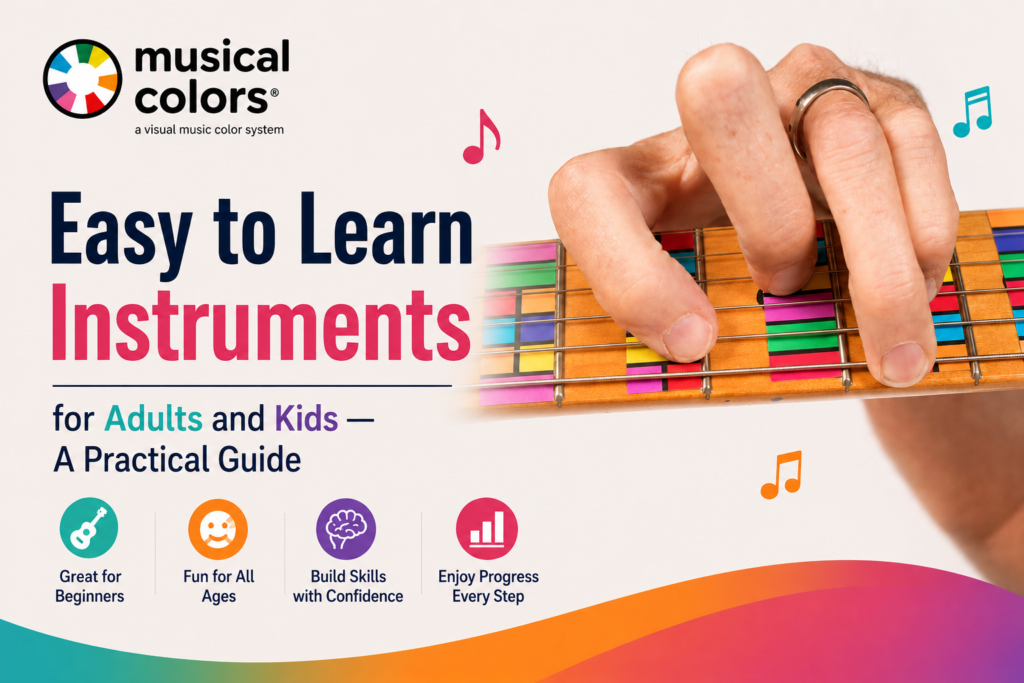
Musical Colors® guitar fretboard sticker guides solve this directly. Once installed, every note on every fret across every string is visible. Beginners can identify notes, see scale patterns, and begin connecting chord shapes to the music theory behind them from the first week rather than the first year.
Best for: Teenagers, adults, singer-songwriters, anyone drawn to rock, folk, pop, or country
Violin — Challenging but Rewarding with the Right Support
The violin has one of the highest early dropout rates of any instrument. It has no frets, no visual note markers, and produces a tone that requires significant technique before it sounds pleasant. None of this means the violin is a bad first instrument — it means the early stages require more support than most instruments get.
Musical Colors® violin fingerboard sticker guides address the single biggest early obstacle: not knowing where the notes are. With color on the fingerboard, students can find note positions visually rather than initially relying entirely on ear and muscle memory from day one. This is why these stickers are widely used by music educators as a foundational teaching aid rather than a shortcut. Students still develop finger and muscle memory, and this process is accelerated by visual guides. After all, violin teachers have been putting thin strips of tape on violin fingerboards for ever.
Best for: Students in formal music programs, disciplined self-starters, children with an interest in classical music
Bass Guitar — The Underrated Best First Instrument for Adults
Bass guitar is significantly undervalued as a beginner instrument. Although heavier, the bass guitar has four strings, a more direct musical role than standard guitar, and chord tone patterns that are less demanding than a six-string, which makes it genuinely accessible for adults who found guitar frustrating. Learning bass also builds a deep understanding of rhythm and harmony that transfers directly to any other instrument.
Musical Colors® bass guitar sticker guides make the full note map of the bass neck visible from the first day, allowing players to connect bass lines to scales and chords far earlier than traditional instruction typically allows.
Best for: Adults returning to music, rhythm-oriented players, anyone who struggled with standard guitar
The Common Factor — Visibility Accelerates Every Instrument
Across every instrument on this list, the pattern is consistent. The instruments that feel easiest to learn are those where either the musical note layout is most visually obvious or is small enough to grasp easily — piano and ukulele are both near the top of beginner-friendly lists for these exact reasons. The instruments that feel harder to play — guitar, violin — are demanding physically and also musical instruments where musical note positions are traditionally not visible externally.
Musical Colors® addresses this directly across every instrument it supports, making the easiest instruments even more accessible and making the difficult ones significantly less intimidating.
Browse all instrument sticker guides in the Musical Colors® shop.