
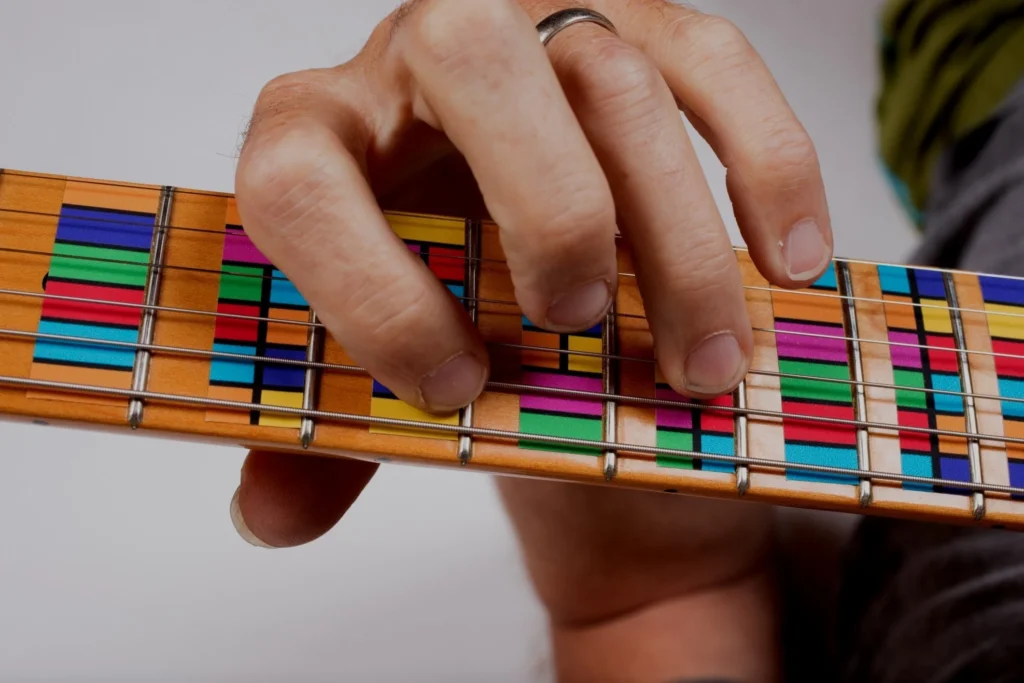
Most guitarists learn their first chords from a chord diagram — a small grid showing finger positions on specific frets and strings. This works well enough in the short term, but it has a significant limitation: it teaches you where to put your fingers without teaching you what you are playing or why it sounds the way it does. Players who learn exclusively from chord diagrams often get stuck, because they have a collection of shapes with no understanding of the system connecting them.
Learning chords visually — in a way that connects shapes to musical notes and musical notes to music theory — is a fundamentally different approach, and it produces fundamentally different results.
What a Chord Actually Is
A chord is a group of notes played simultaneously. The most common chords are triads — three notes built by taking the first, third, and fifth notes of a scale. The C major chord, for example, is built from a C major scale and contains the notes C, E, and G. The G major chord contains the musical notes G, B, and D.
This means that every chord you play on a guitar is a specific selection of notes from the note map of the fretboard. When you play a C major chord shape, you are physically placing your fingers on the notes C, E, and G at positions where those notes happen to sit close enough together to be played simultaneously with one hand.
Most guitarists do not know this, because nothing about the standard guitar makes it visible. The Musical Colors® color-coded fretboard sticker system changes that immediately — the C, E, and G notes in any chord shape are visible as specific colors, so the relationship between the chord shape and the notes that compose it becomes obvious rather than abstract.
The Most Important Guitar Chords for Beginners
Most beginner guitarists learn the same set of open chords first: G major, C major, D major, E minor, A minor, and F major. These six chords cover a large proportion of popular music in multiple genres, and they are all built from notes that appear in the first four frets of the guitar.
With Musical Colors® guitar fretboard sticker guides installed, each of these chords reveals its component notes by color. G major shows Red, Yellow, and Blue at the finger positions. C major shows Green, Indigo, and Red. This visual display does not replace learning the chord shape — it adds a layer of understanding to it that connects the physical shape to the musical structure behind it on the entire instrument.
The Chords page covers the full color-coded chord library including major, minor, and extended chords across all keys.
Why Chord Shapes Are Moveable — and How Color Makes This Clear
One of the most powerful insights in guitar theory is that many chord shapes can be moved up and down the fretboard to play the same chord type in a different key. A barre chord shape that forms G major at the third fret forms A major at the fifth fret, B major at the seventh, and so on.
This works because the shape is selecting the same scale degrees — first, third, fifth — from whichever root note the shape begins on. With a color-coded fretboard, this principle becomes visually apparent. The root note of any barre chord shape is a specific color, and as you slide the shape up the neck, you can see the root note color change as you move from one note to the next. Understanding why a shape works, not just where to put it, is what unlocks the ability to play across the entire fretboard rather than in one or two positions.
Visit the Scales page to see how scales and chord shapes connect across the full fretboard map.
Connecting Chords to Scales — The Key to Musical Creativity
The reason music theory matters for guitarists is not academic. It is creative. When you understand that the chords in a song are built from the same notes as the scale that song is written in, you gain the ability to improvise melodies over those chords without hitting wrong notes — because you know which musical notes belong to the key.
This connection between scales and chords is the foundation of improvisation, songwriting, and musical fluency. It is also exactly what the Musical Colors® system makes visible. Because every note has a fixed color on the fretboard, the notes shared between a chord and a scale appear in the same colors — making the relationship between them something you can see rather than something you have to calculate.
If you are learning guitar and want to move beyond memorized shapes into actual musical understanding, start with guitar fretboard sticker guides and work through the Scales and Chords pages with color-coded reference material on your instrument.