Teaching music to a room full of children – or adults – requires tools that work fast, hold attention, and make abstract concepts immediately tangible. Traditional cerebral music education leans heavily on notation, repetition, and verbal instruction. These methods work, but they work slowly, and they lose a significant portion of students before real musical understanding develops.
Musical Colors® Color-Coded Note Sticker Guides were originally developed by an individual musician but have since become one of the most effective music teaching aids available to classroom instructors, private teachers, and school music programs.
Why Color Works in a Classroom Setting
Color is one of the primary tools the human brain uses to create structure. Before a child can read, they are already categorizing the world by color. This makes color-coded learning tools uniquely powerful in early music education and they meet students where their brains already are.
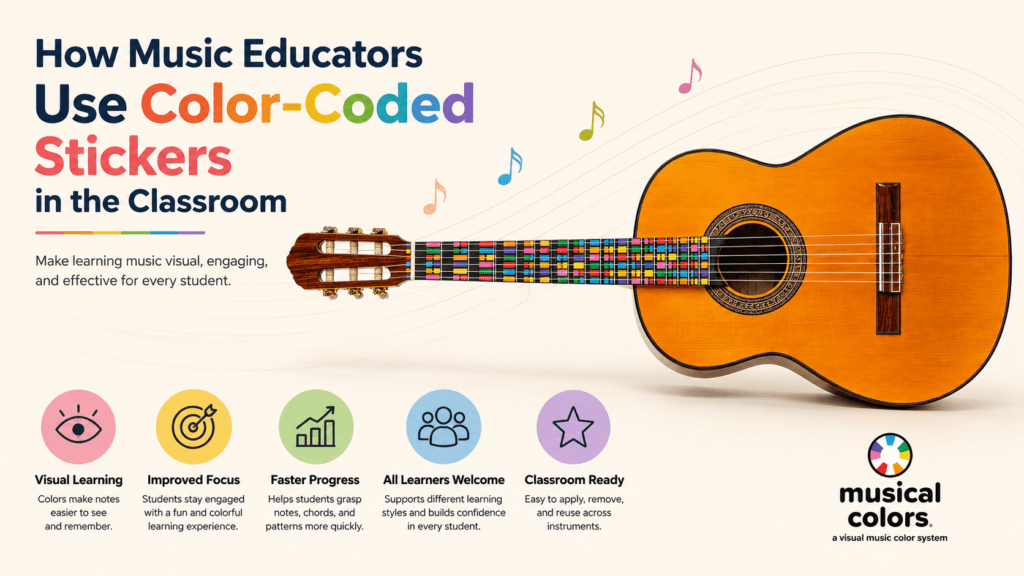
When Musical Colors® Color-Coded Note Sticker Guides are installed on classroom instruments, every student in the room shares the same visual language. The teacher can say, “Find the Red note,” and every student on every instrument, whether guitar, ukulele, piano, chimes or violin and more, can respond immediately and correctly. This shared visual reference system eliminates the communication gap that slows down most group music lessons and helps students remain more interactive.
Practical Classroom Applications
Foundation note identification: In the first lesson, students with Musical Colors® Piano Keyboard Note Sticker Guides or Guitar Fretboard Note Sticker Guides can identify all twelve notes across the entire instrument within minutes by using color. This physical task typically takes weeks or months using traditional methods, but using Musical Colors only accelerates your external visual knowledge and internal visual memory.
Scale teaching: Rather than asking students to memorize which notes belong to a scale, the teacher can describe the scale as a color sequence. The C major scale becomes a specific sequence of colors visible simultaneously on every student’s instrument. Students can see the scale pattern before they understand the theory behind it – and seeing it makes understanding it significantly faster.
Chord construction: Color-coded chords allow educators to show students exactly which notes form any chord by pointing to the colors. Students can then find those colors on their own instruments and build the chord independently – a level of autonomy that traditional chord chart instruction rarely produces in beginners.
Theory visualization: Visual music theory becomes genuinely accessible in a group setting when every student can see the theory on their own instrument in real time. Concepts like intervals, chord construction, and scale relationships stop being abstract and start being visible, which builds inner vision and muscle memory.
What Educators Say About Musical Colors®
Gardner Cole, one of Musical Colors® verified advocates, described the system as “an innovative way to make music fun and easy to comprehend for children and people of all ages.” This is the consistent experience reported by educators – not that it replaces traditional instruction, but that it accelerates the early stages dramatically, allowing students to reach the creative and expressive phases of music much sooner.
Which Instrument Does Musical Colors® Support for Classroom Use?
The system supports every major classroom instrument. Guitar & Bass Guitar fretboard note sticker guides work for school music programs and guitar classes. Ukulele Fretboard Note Sticker Guides are ideal for primary school settings where the ukulele has become the standard beginner instrument. Piano Keyboard Note Sticker Guides work for keyboard labs using top down visual resources. Violin Fingerboard Note Sticker Guides support string programs, and the shared color language across all of these instruments means students who move between instruments in a program carry their color-coded music theory knowledge with them.
The Playground as a Curriculum Resource
For educators who want to go beyond the physical stickers and tap greater resources, the Musical Colors® Playground Membership provides a growing library of over 150 color-coded scales and chords, interactive reference tools like the modulating Circle of Fifths, and on demand music curriculum materials, all built around the same visual color system that the stickers establish physically on the musical instrument.Whether you teach privately, in a school, or in a community program, Musical Colors® educator resources are designed to fit into existing curricula rather than replace them – adding a visual layer that dramatically reduces the time from first individual lessons to genuine personal and musical group expression.