Learning a musical instrument is one of the most rewarding things a person can do, but the early weeks are brutal for most people. Around 82% of people say they wish they could play an instrument, yet only about 20% of those who start ever reach a point where they can play anything confidently. The problem is rarely talent. It is almost always the steep visual learning curve of figuring out where every note lives on your instrument.
That is exactly the problem that Musical Colors® was designed to solve.
What Are Color-Coded Music Note Stickers?
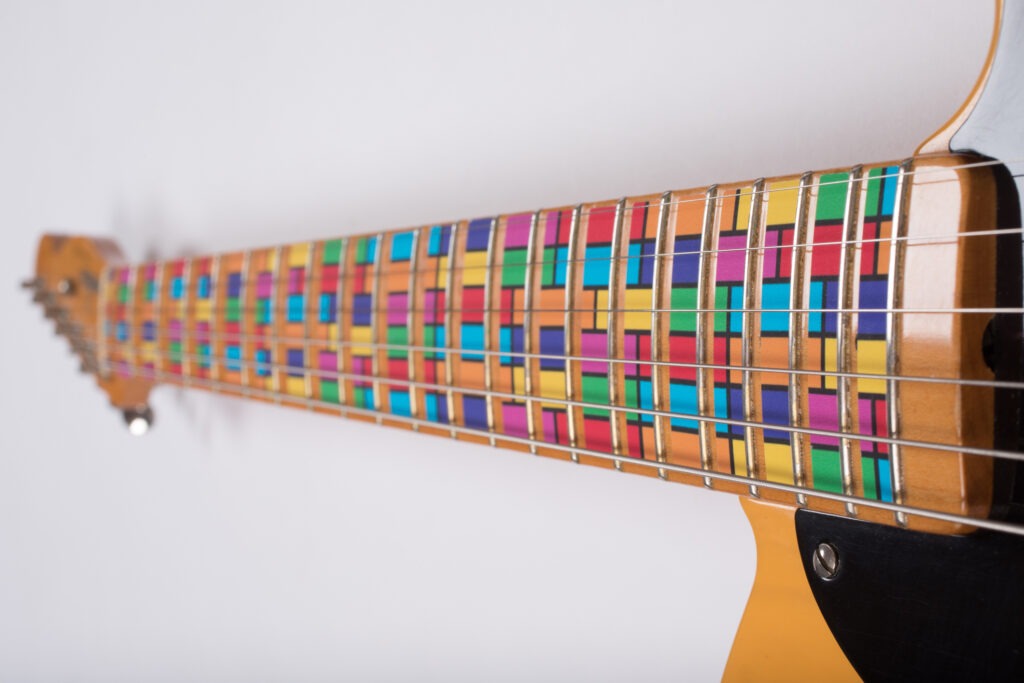
Color-coded music note stickers are precision-cut, instrument-specific sticker guides that are placed directly onto the playing surface of your instrument, whether that is the fretboard of a guitar, the fingerboard of a violin, or the keys of a piano keyboard. Each of the twelve musical notes in Western music is assigned a distinct color, so that when you look at your instrument, you see an immediate visual map of every note available to you.
The Musical Colors® system uses a scientifically grounded color-to-note correlation, one that has roots going back centuries, as documented in the history of color-coded music — to distribute the seven colors of the natural spectrum across all twelve notes, including enharmonic coloring for the five sharps and flats.
Why Visual Learning Works for Music
The human brain processes visual information roughly 60,000 times faster than text. When you are a beginner trying to learn where G is on a guitar fretboard, reading a chart and then hunting for the note is slow, frustrating, and discouraging. When G is simply the color Red everywhere on your instrument, the note becomes something you see rather than something you remember.
This is why visual music theory has such a dramatic impact on beginners. Instead of building abstract mental maps from memory, your brain starts associating colors with sounds — a process that is both faster and more durable.
How the Stickers Work in Practice
Once your guitar fretboard sticker guides or piano keyboard note stickers are installed, the learning process changes immediately. Here is what most beginners experience in the first week:
Day 1–2: You stop guessing where notes are. The colors tell you instantly. You spend more time actually playing and less time cross-referencing charts.
Day 3–5: You begin to see scale patterns on the fretboard as color groupings rather than isolated dots. The C major scale, for example, becomes a recognizable color sequence you can find anywhere on the neck.
Day 6–7: You start connecting colors to chord shapes. When you understand that a G major chord is built from three specific colors, building and recognizing chords becomes a visual exercise rather than a memory one.
Which Instruments Do the Stickers Work With?
Musical Colors® currently offers color-coded note sticker guides for the following instruments, all available in the Musical Colors® shop:
- Guitar Fretboard Note Sticker Guides — for 6-string, 12-string, full-size, and ¾ size guitars in multiple neck widths and tunings
- Bass Guitar Fretboard Sticker Guides — for 4-string bass players
- Ukulele Fretboard Sticker Guides — for 4-string soprano, concert, and tenor ukuleles
- Mandolin & Banjo Sticker Guides — for 8-string mandolins and 5-string banjos
- Piano Keyboard Note Sticker Guides — for 25 to 88 key instruments
- Violin Fingerboard Sticker Guides — for student and full-size violins
- Percussion Instrument Sticker Guides — for percussion instrument surfaces
- More in development…
Will the Stickers Damage My Instrument?
No. Every Musical Colors® sticker guide is made from thin polypropylene with an acid-free adhesive that is gentle on instrument surfaces. They are precision cut; laser sealed and will not leave residue or damage the finish when removed correctly. They are also designed not to hinder playability when installed properly.
Who Benefits the Most?
While beginners of all ages see the most dramatic improvement, the stickers are genuinely useful across all skill levels. Self-taught musicians who have been playing for years often discover they have gaps in their fretboard knowledge that the color system immediately fills. Music educators use them to accelerate student progress in classroom settings. Even experienced players use them as a reference tool when composing or improvising.
If you have been struggling to get past the beginner plateau, the problem may not be your practice, it may be that you have been trying to learn visually without a visual tool. Start with the Musical Colors® system and see the difference color makes.