
Improvisation is one of the most exciting things you can do on a guitar. It is also one of the most frustrating things to learn. Most guitarists hit a wall where they know a few licks, they understand the concept of a key, but the moment they try to freely improvise, they hit notes that clash, and the music falls apart.
The reason is almost always the same: they cannot see the scale.
This is not a theory problem or a talent problem. It is a visualization problem, and it is exactly what the Musical Colors® visual music system was originally built to solve. In fact, the founder of Musical Colors® developed the entire system in 1991 at the University of Arizona specifically because he needed a way to stay in key while improvising on classical guitar.
Why Improvisation Feels Random Without a Visual Reference
When you improvise, you are making real-time decisions about which notes to play next. If you cannot immediately see which notes belong to the key you are in, you are essentially guessing, and your ear alone is not fast enough at the beginner or intermediate stage to catch wrong choices before your fingers play them.
Music theory teaches you which notes belong to which scale intellectually. But intellectual knowledge does not translate fast enough into physical decisions when you are playing in real time. What you need is something your eyes can process instantly, which is where color-coded fretboard stickers change everything, and your internal visual memory explodes.
How Color Makes the Scale Visible
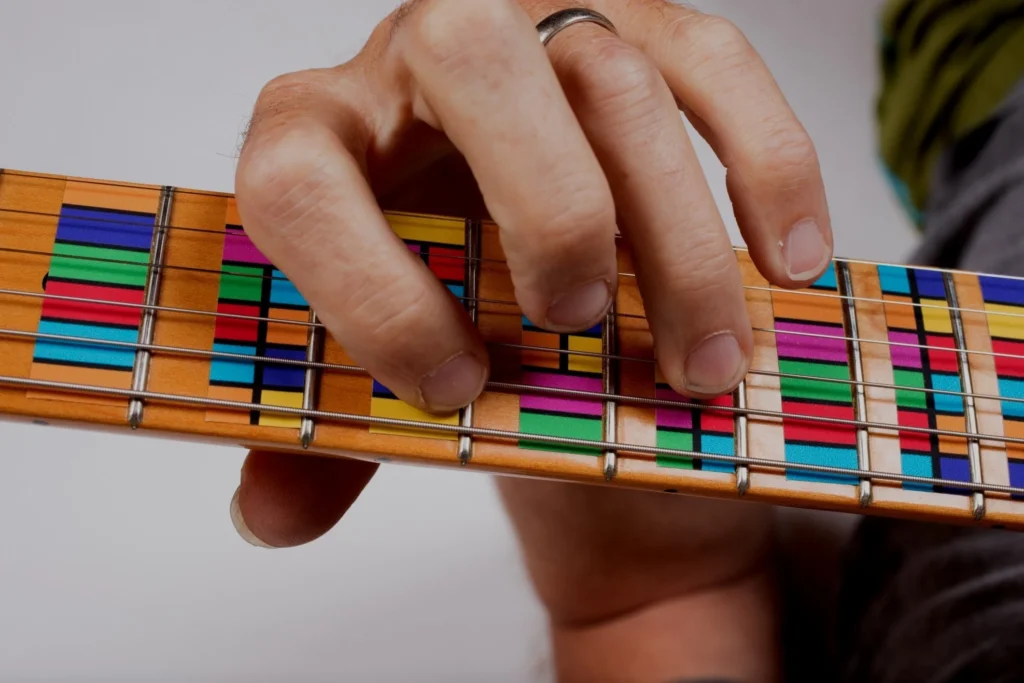
With Musical Colors® guitar fretboard note sticker guides installed on your neck, every one of the twelve notes has its own color. When you decide to play in the key of G Major, the notes of that scale, G, A, B, C, D, E, and F# are all visible as specific colors across every fret and every string simultaneously.
You no longer have to remember which frets to avoid. You can see the visual patterns on the fretboard that belong to your key. Your improvisation becomes a conversation between your ear and your eyes rather than a gamble.
A Simple Three-Step Method to Start Improvising in Key
Step 1 -Choose your key and find the root note color. Using the Musical Colors® system, every note has a fixed color everywhere on the neck. If you are improvising in G major, find the color for G (Red in the Musical Colors® system) and use those positions as your anchor points, the notes you return to when you want to resolve a phrase.
Step 2 – Learn the scale pattern as a color sequence. Visit the Musical Colors® Scales page and study the C major and A minor color sequences first, as these use only the natural notes, the solid colors, making the pattern easiest to see. Practice running up and down the scale slowly until the color sequence feels familiar under your fingers.
Step 3 – Improvise inside the colors. Once you can see the scale visually, begin improvising while restricting yourself only to the note colors in your chosen key. At first, move slowly and deliberately. Over time, your fingers will learn to trust the colors instinctively and your playing will become more fluid and expressive. If you want to go deeper with over 150 color-coded scales and exotic tunings, the Musical Colors® Playground membership unlocks the full library.
The Difference Between Playing Notes and Playing Music
Staying in key is only the first step. Once you are confident that your notes are not clashing, you can start paying attention to phrasing, how long you hold notes, when you create tension and when you resolve it, and how you use silence. These are the elements that turn improvisation into actual music.
The color-coded chords in the Musical Colors® system also help here. When you can see which chord is being played beneath your improvisation, you can target the notes of that chord, called chord tones, to make your lines sound intentional and musical rather than scalar.
For Intermediates Who Feel Stuck
If you have been playing for a while but your improvisation still sounds like you are running scales rather than making music, the problem is often that you are thinking in patterns rather than thinking in sounds. The Musical Colors® Playground Membership was built specifically for this stage, with interactive modulation tools, the Circle of Fifths playground, and a growing library of exotic scales that push your playing into new creative territory.Whether you are picking up the guitar for the first time or you have been playing for years and want to unlock the fretboard more deeply, color is the fastest path to musical freedom. Start seeing your instrument and start playing it differently.